

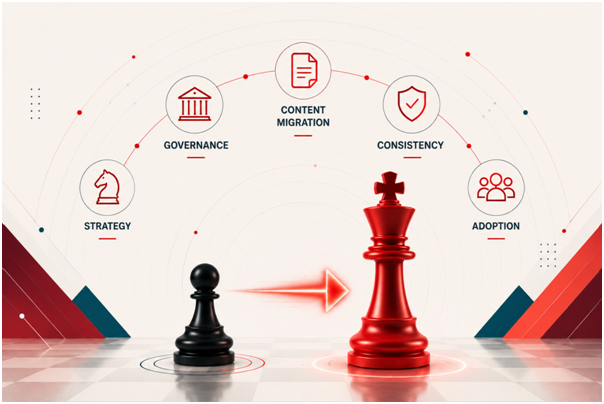
The hidden operational challenge every enterprise must prepare for
Executive perspective: Having spent more than two decades supporting global organizations through presentation transformation and enterprise design operations, one lesson has remained constant: a new brand is never just a new logo. For large organizations, rebranding signals strategic change—whether driven by a new vision, merger or acquisition, market repositioning, or renewed customer commitment. Yet the success of that change depends less on launch-day visibility and more on how consistently the new identity is adopted across the enterprise.
The question is no longer: “Have we launched the new brand?”
The real question is: “Has the organization truly adopted it?”
Across the enterprise, thousands of PowerPoint presentations, proposal decks, sales materials, training documents, executive briefings, templates, reports, and knowledge assets continue to circulate every day. Unless these assets are updated systematically, organizations risk sending mixed brand signals long after the official launch.
Rebranding is a Business Transformation Initiative
From a CXO perspective, rebranding is not a design exercise. It is an enterprise-wide change management program that touches customers, employees, partners, investors, and every function that communicates on behalf of the business.
Every customer touchpoint contributes to brand perception:
- A sales presentation delivered to a strategic account
- A consulting proposal sent to a prospective client
- A leadership keynote shared at an industry forum
- A client onboarding deck used by delivery teams
- An internal training presentation distributed across business units
If even a small percentage of these assets continue using outdated branding, inconsistencies begin to emerge. Customers notice. Employees become uncertain about which assets to use. Business units start creating their own interpretations of the new brand, gradually diluting the identity the organization worked hard to establish.
For that reason, the strongest rebranding programs are treated as operational transformations, not simply marketing initiatives.
The Often-Overlooked Challenge: Legacy Content
One of the largest hidden costs of rebranding is the volume and complexity of existing content. In most enterprises, critical knowledge assets are not static; they continue to be reused, repurposed, and redistributed for years.
Typical enterprise content estates include:
- Thousands of PowerPoint presentations
- Proposal libraries
- Sales enablement content
- Training materials
- Executive communication decks
- Marketing collateral
- Templates
- Knowledge repositories
These assets often continue to create value long after the original campaign, meeting, or project has ended. Starting over is rarely practical, and in most cases, it is not economical.
A more sustainable approach is structured migration: preserving the business logic, structure, messaging, usability, and visual quality of each asset while aligning it with the new brand.
Rebranding legacy content is not a logo-replacement exercise. It is a structured migration of business-critical communication assets.
Effective migration requires an understanding of presentation architecture, Slide Masters, typography, layouts, charts, icons, diagrams, animations, brand standards, accessibility requirements, and user behavior.
At scale, the real test is not whether a single file can be converted well. It is whether thousands of files, created over many years by different teams, can move into the new brand with the same level of consistency.
Why Centralized Governance Matters
Governance is often the difference between a rebrand that scales and a rebrand that fragments. Without centralized ownership, even well-intentioned teams can introduce inconsistency into the system.
Without centralized governance:
- Teams interpret brand guidelines differently.
- Departments create local variations.
- External vendors produce inconsistent outputs.
- Legacy assets continue circulating.
- Employees lose confidence in official templates.
Centralized governance brings clarity to that complexity.
It gives teams a single source of truth for templates, design standards, quality control, approval workflows, version management, rollout priorities, and escalation paths.
Leadership also gains a practical way to monitor progress across business units and confirm that customer-facing assets reflect the organization’s new identity with consistency and confidence.
With the right controls in place, rebranding becomes more than a launch moment; it becomes sustained brand adoption.
Choosing the Right Outsourcing Partner
For many organizations, the scale of enterprise rebranding exceeds internal design and production capacity. Internal teams are typically focused on launch campaigns, new brand assets, leadership communications, and business enablement.
Adding thousands of document and presentation conversions to that workload can slow the transformation effort and increase execution risk.
That is why many global organizations extend their internal capabilities through specialized partners.
Design capability matters, but outsourcing a rebrand demands much more.
Organizations should look for partners with proven capability in:
- Enterprise-scale delivery
- Confidentiality and secure handling of sensitive business information
- Structured project management
- Quality assurance processes
- Brand governance
- Executive presentation standards
- Tight timelines and phased rollouts
- Collaboration with multiple stakeholders across departments and geographies
Speed is only one part of the equation.
The larger objective is to ensure that every converted document strengthens the new brand instead of introducing fresh inconsistencies.
Experience Matters More Than Ever
Enterprise rebranding projects are rarely linear. Brand guidelines evolve, stakeholder reviews overlap, priorities shift, and legacy content varies widely in quality, structure, and business criticality.
For multinational organizations, the complexity often expands further across multilingual documents, regional variations, accessibility requirements, and phased rollout schedules.
Having supported enterprise presentation teams through large-scale branding initiatives over many years, we have learned that successful rebranding is rarely constrained by design capability alone. It succeeds through governance, consistency, and disciplined execution.
We’ve seen organizations discover that the real challenge isn’t converting thousands of files. It’s ensuring every one of those files continues to communicate the business with the same confidence the new brand was designed to represent.
In our experience, organizations are most successful when they can rely on a partner that brings structured governance, scalable delivery, and enough enterprise experience to anticipate challenges before they become delays. The right partner becomes an extension of the internal team rather than an external vendor.
Supporting the Entire Rebranding Journey
At VisualSpiders, we support organizations through complex presentation design and large-scale document transformation initiatives, helping teams translate brand strategy into consistent execution across everyday business communication.
Our role goes beyond redesigning slides.
We help organizations maintain consistency throughout the rebranding lifecycle through:
- Large-scale PowerPoint rebranding and migration
- Custom PowerPoint template development
- Slide Master redesign and implementation
- Brand-compliant presentation libraries
- Executive and client presentation updates
- Quality assurance and brand consistency reviews
- Ongoing presentation support during phased rollouts
Every engagement is supported by structured processes, experienced presentation professionals, strong quality controls, and strict confidentiality standards.
Our objective is straightforward: enable organizations to lead the transformation while we help ensure every presentation reflects the new brand with clarity, consistency, and precision.
Rebranding is Ultimately About Trust
A brand is a promise. Every presentation, proposal, report, and customer interaction either reinforces or weakens that promise.
Managed thoughtfully, a rebrand creates confidence among employees, customers, investors, and partners.
Executed inconsistently, even the strongest visual identity can lose impact.
The organizations that succeed recognize rebranding as both a strategic and operational initiative. They invest in governance, establish clear ownership, engage experienced partners where appropriate, and ensure that every customer-facing document reflects the same standard of excellence.
Because in the end, successful rebranding is not measured by the day the new logo is unveiled.
Successful rebranding is not measured by the day the new logo is unveiled. It is measured by how consistently the organization lives the new brand in every interaction that follows.
Ready to Scale Your Rebrand Across Every Presentation?
Rebranding is one of the few initiatives that touches every employee, every customer interaction, and every business function. Choosing the right execution partner can determine whether the new brand becomes a lasting organizational standard or simply a successful launch campaign.
At VisualSpiders, our goal is to help organizations make that transition with confidence by translating brand strategy into consistent, boardroom-ready business communication across presentations, templates, and everyday enterprise content.
VisualSpiders helps enterprise teams turn rebranding into sustained adoption—through disciplined execution, consistent presentation systems, and communication assets built for business impact.
If your organization is preparing for a rebrand, we’d be happy to share our experience, discuss your challenges, and explore how VisualSpiders can support your internal teams throughout the transition.